My New Book is Out!
Order it through Rutgers, Amazon, Bookshop, or wherever you get books.
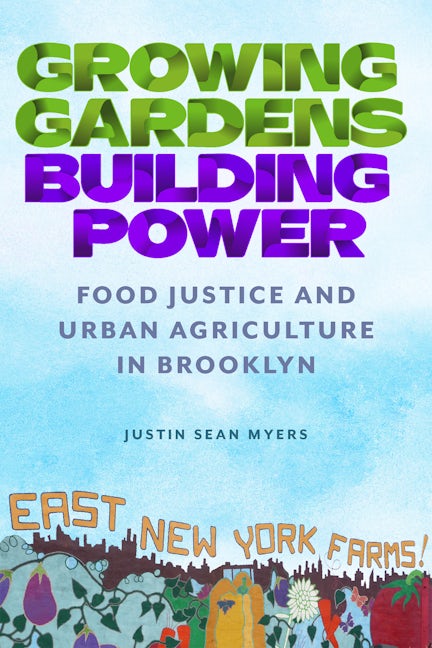
Synopsis: Across the United States marginalized communities are organizing to address social, economic, and environmental inequities through building community food systems rooted in the principles of social justice. But how exactly are communities doing this work, why are residents tackling these issues through food, what are their successes, and what barriers are they encountering?
This book dives into the heart of the food justice movement through an exploration of East New York Farms! (ENYF!), one of the oldest food justice organizations in Brooklyn, and one that emerged from a bottom-up asset-oriented development model. It details the food inequities the community faces and what produced them, how and why residents mobilized to turn vacant land into community gardens, and the struggles the organization has encountered as they worked to feed residents through urban farms and farmers markets.
This book also discusses how through the politics of food justice, ENYF! has challenged the growth-oriented development politics of City Hall, opposed the neoliberalization of food politics, navigated the funding constraints of philanthropy and the welfare state, and opposed the entrance of a Walmart into their community.
Through telling this story, Growing Gardens, Building Power offers insights into how the food justice movement is challenging the major structures and institutions that seek to curtail the transformative power of the food justice movement and its efforts to build a more just and sustainable world.

Justin Sean Myers (PhD, CUNY) is Associate Professor of Sociology at Fresno State and Director of the College of Social Sciences Honors Program.
His research explores how the social organization of power shapes the distribution of social, economic, and environmental benefits and burdens in society, especially along lines of class, race, gender, and nationality. In particular, he focus on how conflicts over the production, appropriation, and allocation of these benefits and burdens play out between communities, organizations, state-based actors, and corporations.
Previous work has centered specifically on how privileged communities have worked to secure and maintain exclusionary environmental benefits through practices of opportunity hoarding as well as how marginalized communities have mobilized to both reduce the environmental burdens that residents experience as well as increase the environmental amenities available to locals.
You can read his work in the journals Agriculture & Human Values, Geoforum, and Environmental Sociology and the books Ten Lessons in Introductory Sociology, Twenty Lessons in the Sociology of Food and Agriculture, and Twenty Lessons in Environmental Sociology.
 Justin Sean Myers